
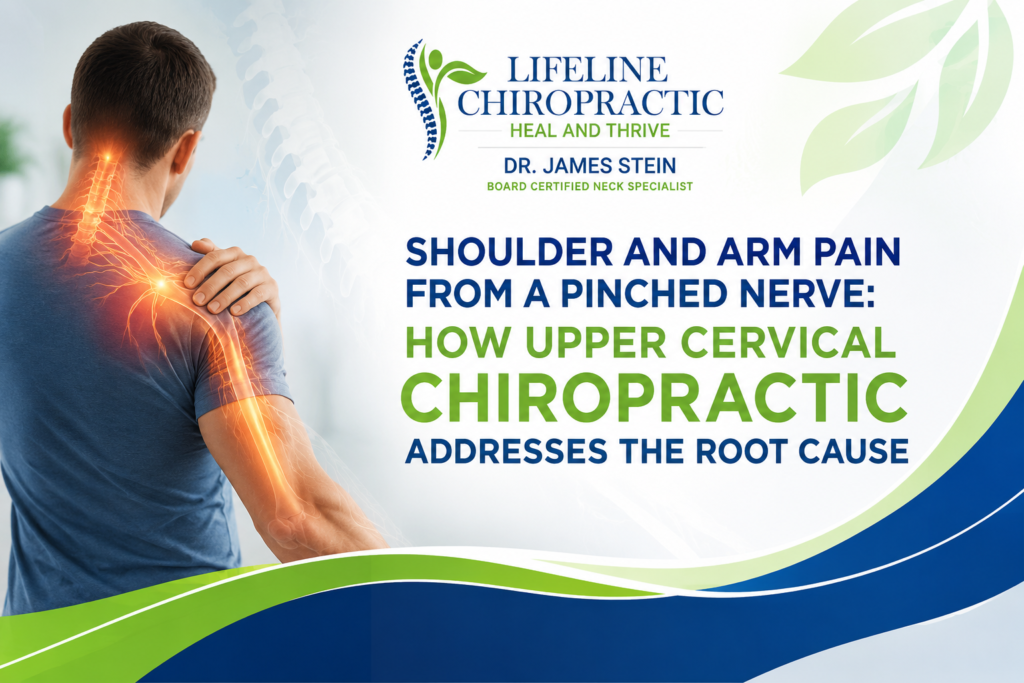
Pain, numbness, or tingling that radiates from the neck into the shoulder, arm, or hand is one of the most common and frustrating conditions that brings patients to Lifeline Chiropractic. It is often diagnosed as cervical radiculopathy — a pinched nerve in the neck — and while the diagnosis is accurate, the treatment approach matters enormously.
Most conventional treatment focuses on the site of nerve compression itself. Anti-inflammatories reduce local swelling. Physical therapy strengthens the surrounding muscles. Injections manage pain. In severe cases, surgery decompresses the nerve root. But there is a dimension of cervical nerve compression that is frequently overlooked: the role of upper cervical misalignment in creating the postural and structural conditions that allow nerve compression to develop.
How Cervical Nerve Compression Actually Develops
The cervical spine has eight nerve roots, C1–C8, that exit between the vertebrae and travel into the shoulder, arm, and hand. When one is compressed – by a herniated disc, bone spur, or narrowed foramen — it produces the characteristic radiating pain, numbness, tingling, or weakness.
When the atlas is displaced, the entire cervical spine compensates — tilting, rotating, and creating uneven loading patterns. This compensation increases pressure on the discs and nerve exit points throughout the neck, creating the conditions in which disc herniation and nerve root compression are more likely to develop.
The Supporting Tissue Component
When the atlas is misaligned, the muscles of the neck, shoulder, and upper back — particularly the SCM, scalenes, and trapezius — enter a state of chronic compensation. Over time, this chronic muscle tension becomes its own source of nerve compression. The scalenes, for example, sit directly adjacent to the brachial plexus nerve bundle that supplies the arm.
When the atlas is corrected and structural load normalizes, these muscles often release almost immediately — patients describe shoulder and upper arm tension releasing within the first session in a way that years of massage never produced.
What to Expect at Lifeline Chiropractic for Shoulder and Arm Pain
Dr. Stein begins with a thorough consultation including a detailed history of when arm symptoms began, whether neck pain preceded them, and any history of neck injury. A neurological assessment identifies which nerve root is affected. Precise imaging measures atlas position and cervical alignment. If indicated, an Atlas Orthogonal correction is performed. Most patients with cervical radiculopathy notice a change in arm symptoms within the first few weeks.
Frequently Asked Questions
Q Can a chiropractor help a pinched nerve in the neck near Philadelphia?
Yes. Dr. James Stein addresses cervical nerve compression through neuro-focused upper cervical chiropractic care. Call 610-630-9800 or visit drjsteinchiropractor.com.
Q Can upper cervical chiropractic help shoulder and arm pain from a herniated disc?
Upper cervical care can be part of an effective treatment approach for cervical disc herniation. By restoring proper alignment, abnormal load on the affected disc is reduced, which may allow the disc to heal and nerve compression to decrease.
| If you are dealing with shoulder or arm pain from a pinched nerve and want a non-surgical solution in the Norristown or Philadelphia area, schedule a consultation at Lifeline Chiropractic. 2525 W Main St, Norristown, PA 19403. Call 610-630-9800 or visit drjsteinchiropractor.com. |