
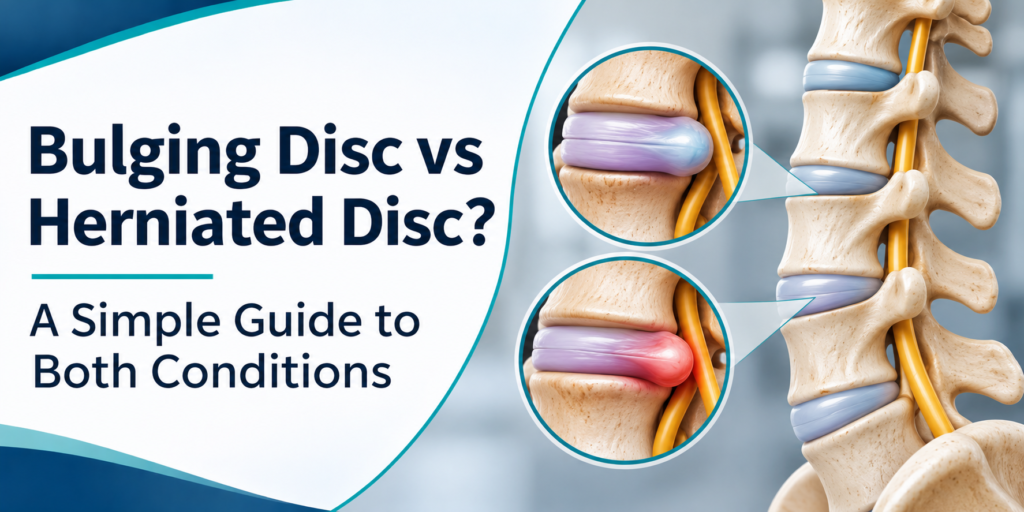
You bend down to pick up a sock, and suddenly, the bulging disc vs herniated disc question hits close to home. Maybe your back twinged, or perhaps a sharp pain traveled down your leg. When you first heard these terms, they might have sounded like two ways of describing the same problem. They’re not quite the same. The main difference is whether the disc’s tough outer layer bulges outward while remaining intact or develops a tear that allows some of its inner material to push through.
How a Healthy Disc Works
Picture a jelly donut sitting between two vertebrae. A soft center rests inside a firmer outer ring, and together they cushion every step, lift, twist, and cough. Years of sitting, heavy work, smoking, and plain aging wear that ring down, and spinal disc problems often start there. The disc dries out. Tiny cracks form. It still works, just not as well.
What Is a Bulging Disc?
In a bulge, the outer ring stays whole but pushes outward past its normal edge, like a tire sagging under weight. The soft center hasn’t escaped. Plenty of people never feel it, and that’s not a guess. A well known 1994 study in the New England Journal of Medicine scanned 98 adults with no back pain, and 52 percent had a bulge at one or more levels. When pain does show up, bulging disc symptoms tend to be milder: a dull ache in the neck or low back, stiffness after sitting, a bit of tingling. It’s the quieter of the two.
What Is a Herniated Disc?
With a herniated disc, the tough outer layer develops a crack or tear, allowing some of the soft material inside to push outward. That material can press against a nearby nerve and irritate it. As a result, herniated disc symptoms may be more intense and include sharp pain, numbness or weakness in an arm or leg, often on just one side. Where the disc is located makes a difference, too. A herniation in the lower back can send pain down the leg, while one in the neck may cause symptoms that travel into the shoulder and hand. Same type of problem, different part of the body.
Protrusion, Extrusion, and the “Slipped Disc” Myth
An MRI report may describe the disc changes using different terms. A radiologist may use disc protrusion when part of the disc extends outward in a more localized way. Extrusion describes a situation in which disc material extends farther through the outer layer. These terms refer to the disc’s shape and structure rather than the severity of your symptoms. A term that sounds serious on a scan doesn’t necessarily mean you’ll have severe pain.
Then there’s the slipped disc. It’s a popular phrase and a misleading one. Discs don’t slide out of place like a book off a shelf, because they’re anchored between the vertebrae. When people say slipped disc, they almost always mean a herniation.
What Raises Your Risk
Age and genetics aren’t things you can change, but other risk factors are more within your control. Smoking, carrying extra weight around your waist, spending the day at a desk without standing up, and lifting with a rounded back can all add to the strain on your back. Disc problems often develop little by little, without any obvious warning. Then a routine action, such as sneezing or shoveling snow, suddenly sets off the pain. Even picking up something as ordinary as a garden hose can be the moment you first notice it.
Getting the Right Diagnosis
If you’re researching lower back pain and spinal decompression, here’s something worth knowing: an MRI doesn’t tell the whole story. Herniated and bulging and discs can produce similar symptoms, and some people have one of these findings on an MRI without experiencing any pain at all. That’s why a proper examination matters. A healthcare professional will look at your medical history, check your reflexes and muscle strength, and assess nerve function. Imaging may be recommended when the findings are needed to understand what’s causing your symptoms.
What Treatment Usually Looks Like
The reassuring news is that many people recover from pain caused by either condition without surgery. Surgery is generally reserved for more severe cases. In the meantime, gentle walking, taking breaks throughout the whole day, and avoiding long periods of sitting may help you feel more comfortable as you recover. If you’re looking for hands-on help in your area, chiropractic care in Norristown PA is an option to discuss, especially if medication hasn’t provided enough relief. A proper examination should always come before a treatment plan.
Some people with persistent disc herniations also look into spinal decompression therapy, which uses gentle stretching to try to reduce pressure on a spinal disc. However, the research supporting this treatment is still limited, and it isn’t suitable for everyone. Talk with your healthcare provider to find out whether it makes sense for your particular situation.
When It Can’t Wait
One warning. Numbness between the legs, trouble controlling your bladder or bowels, or weakness spreading through both legs needs emergency care today. Don’t wait for an appointment.
Conclusion
A bulge is a stretched wall that’s still intact. A herniation is a tear with material leaking out. Both are common, both often settle without surgery, and neither is a life sentence. What you feel matters more than the word on the report. Get it checked, then build a plan that fits.
Ready for Answers?
Still unsure what’s behind your back or neck pain? Contact Lifeline Chiropractic in Norristown, PA, to book a visit. We’ll help you sort out what’s really going on.
FAQs
Can a bulging disc turn into a herniated disc?
Yes, it can, especially if the outer wall keeps weakening. Most bulges never get there, though.
Which one is worse?
Herniations usually cause more trouble because the inner material can touch a nerve. Still, pain level isn’t a perfect measure of damage.
Do these heal without surgery?
Often, yes. Many people improve over several weeks with movement and conservative care.
How are they diagnosed?
A physical exam comes first. An MRI or CT scan helps when symptoms are severe or don’t improve.
When should I get checked?
If pain lingers past a couple of weeks, travels into an arm or leg, or comes with numbness or weakness, get it looked at soon.