
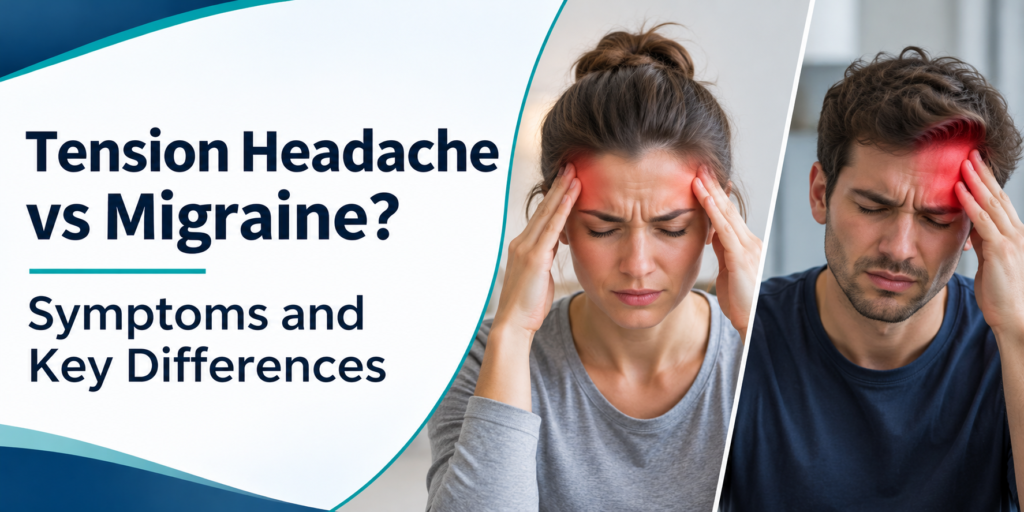
It’s 3 p.m., your head is starting to hurt, and you’re once again trying to figure out tension headache vs migraine. Could it be stress, or is something else going on? You’re not alone in wondering. These two types of headaches share several symptoms, so telling them apart isn’t always easy. The good news is that they often have different patterns once you know what to look for. This guide explains those differences using information from major medical sources.
What a Tension Headache Feels Like
A tension headache can feel as though someone has wrapped a tight band around your skull and won’t let go.The most common tension headache symptoms include a steady, dull ache, pressure across the forehead or the sides and back of the head, and sore muscles around the scalp, neck, and shoulders. According to Mayo Clinic, the pain is usually mild to moderate. You can often carry on with work or other everyday tasks, even though the discomfort can be frustrating.
An episodic tension headache can last anywhere from 30 minutes to a full week. Chronic tension headaches are different because they occur on 15 or more days each month for at least three months. Almost everyone experiences this type of headache at some point, so it’s a common problem. Sometimes, a little rest, a warm shower, or a short walk can help ease the discomfort. Nausea and strong sensitivity to light or sound are less common, although they can still occur.
What a Migraine Looks Like
If you have ever had a migraine, you’ll know it can feel very different from a regular headache. The pain often throbs, usually affects one side of the head, and can come with nausea, vomiting, or sensitivity to light and sound. An attack can last for 4 to 72 hours if left untreated. Sometimes, the first clues arrive before the pain does. These migraine warning signs may include a stiff neck, frequent yawning, cravings for certain foods, or changes in mood. They can show up a day or two ahead of the headache, making them easy to overlook. About one-third of people also experience an aura, such as flashing lights, blind spots, tingling in an arm, or trouble speaking. These symptoms usually develop gradually and pass within an hour.
Even after the headache fades, you might not feel completely back to normal. Fatigue, brain fog, and a drained feeling can stick around for another day. Movement can also help you tell the difference between a migraine and a tension headache. Physical activity often makes migraine pain worse, while tension headache pain generally doesn’t change much with movement. If you’d rather rest in a dark, quiet room than walk up a flight of stairs, a migraine may be the more likely explanation.
How the Two Compare
There are many headache types, yet these two cause most of the confusion. Tension headaches are the most common of all. Migraines are less common but hit harder. Women are about three times more likely than men to get migraines, which tend to peak in your 30s.
Looking at a headache comparison can give you a few clues about what’s going on. Tension headaches usually feel like a tight pressure around both sides of your head. Migraines, on the other hand, often bring throbbing pain that’s stronger on one side. Feeling nauseated is less common with tension headaches but much more common with migraines. Aura symptoms, including flashing lights or blind spots, also point toward migraine rather than tension headache. Still, it’s not always easy to tell. A mild migraine can feel almost identical to a tension headache, and chronic migraine can come with ongoing head pain that feels like a tension headache, too. Don’t feel bad if the symptoms leave you guessing. Even a doctor needs to understand your complete symptom history before drawing conclusions.
What Causes Each One
The honest truth about tension headache causes is that nobody knows for sure. Experts used to blame tight muscles in the face, neck, and scalp. Newer research says muscle contraction isn’t the cause. The leading theory points to a pain system that’s extra sensitive, and the muscle tenderness may be a result of that. Stress is the trigger people report most.
Migraine has deeper roots. Genetics and environment both play a part, and the brainstem, the trigeminal nerve, and brain chemicals like serotonin seem to be involved. Triggers vary. Common ones include missed sleep, skipped meals, alcohol, caffeine, strong smells, weather shifts, and hormone changes. A simple diary helps you spot your own pattern. Many people exploring natural migraine treatment options start with exactly that kind of tracking, because it shows what to avoid before anything else is added.
When to Get Help
See a healthcare professional if you need medicine for headaches more than twice a week, or if they keep disrupting your life. Taking aspirin or ibuprofen on more than 14 days a month can backfire and cause medication overuse headaches. Seek emergency care for a sudden, thunderclap headache, or one that comes with fever, a stiff neck, confusion, double vision, weakness, numbness, or trouble speaking. Same goes for a headache after a head injury, or a brand new headache after age 50.
Once serious causes are ruled out, it makes sense to look at all your migraine care options, from medication to lifestyle changes to hands on approaches. Ask questions. Compare. Pick what fits your life.
Neck tension often travels with head pain, which is why some people in Montgomery County look into chiropractic care in Norristown PA after getting a medical checkup. It’s a drug free path worth understanding, not a shortcut around a proper diagnosis.
Conclusion
Tension headaches squeeze both sides, stay mild to moderate, and rarely upset your stomach. Migraines throb, often on one side, and can bring nausea, light sensitivity, and sometimes an aura. Knowing which one you have makes everything easier, from tracking triggers to choosing treatment. Keep a diary. Watch the pattern. If your headaches don’t match either description, that’s worth a conversation too. And never ignore a headache that suddenly feels different.
Ready for Answers?
Headaches that keep coming back deserve a real plan. If you’re ready to talk, contact Lifeline Chiropractic in Norristown, PA, where Dr. James Stein, a board certified neck specialist, has served the community since 1996.
FAQs
Can a tension headache turn into a migraine?
They’re separate conditions, but mild migraines can feel like tension headaches, and chronic migraine often brings background pain that feels similar.
How long does each one last?
Episodic tension headaches last 30 minutes to a week. An untreated migraine lasts 4 to 72 hours.
Do tension headaches cause nausea?
Not usually. Nausea and vomiting point more toward migraine.
Does stress trigger both?
Yes. Stress is the trigger people most often report for tension headaches, and it can bring on migraines, too.
When is a headache an emergency?
A sudden, severe headache, or one with fever, stiff neck, confusion, weakness, or trouble speaking, needs emergency care right away.