
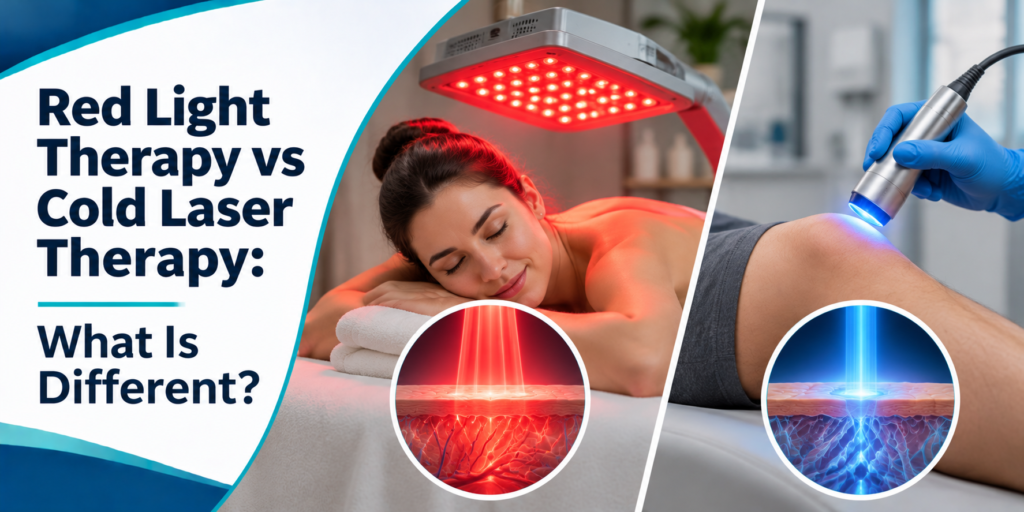
Your cousin swears by a glowing red panel, your clinic offers a handheld probe, and now you’re stuck on cold laser therapy vs red light therapy. Fair question. They’re related, but they’re not twins.
What They Have in Common
At their core, both treatments fall under photobiomodulation. The term simply describes the use of light to produce a biological response in the body. Researchers think cells absorb specific wavelengths of light and respond in ways that may help calm inflammation and encourage tissue repair. Unlike treatments that rely on heat or cutting, neither method is intended to damage tissue in that way. This is where the term “cold laser” comes from. Both treatments share the same general principle, but the devices used to deliver the light differ.
What Cold Laser Therapy Is
Low level laser therapy, commonly called LLLT, uses a laser diode that produces light at one specific wavelength. Clinics generally administer the treatment with a handheld probe positioned over the area causing pain. The device’s power output is typically less than 500 milliwatts, although some probes use several emitters at once. Infrared light is often selected for pain-related treatments, with wavelengths commonly falling between 800 and 910 nanometers.
A therapeutic laser is different from a surgical laser designed to cut or burn tissue. Instead, it delivers a small, carefully measured amount of energy. Getting the dose right matters. A review of joint pain studies found that treatments using doses below the recommended range showed no benefit, while those using doses within the recommended range did. Protective eyewear is also standard during treatment.
What Red Light Therapy Is
Red light treatment usually uses LED lights rather than lasers. The main difference is how the light is produced and delivered. LEDs spread light across a wider range of wavelengths and cover more surface area at once. They also tend to use less power, which makes them a popular choice for home-use products such as light panels and flexible wraps. Most devices use red light in the 630 to 660 nanometer range or near-infrared light around 830 nanometers. Many products are marketed for skin care, but the benefits claimed by manufacturers vary from one device to another.
Key Differences
For laser pain treatment, the differences come down to a few things:
- Light: Laser light is focused and coherent. LED light is spread out.
- Power: Lasers pack more power into a small spot.
- Setting: Lasers are applied in a clinic with a probe. LED panels are common at home.
- Target: A laser aims at one area. An LED can cover a broad one.
- Depth: Laser light is often described as reaching deeper, though depth also depends on wavelength.
What the Research Says
The research is more promising than some skeptics might expect, although there are still gaps in the evidence. A 2009 review published in The Lancet analyzed 16 trials involving 820 patients. It found that laser treatment reduced acute neck pain immediately and helped relieve chronic neck pain for up to 22 weeks after treatment ended. However, a 2013 review concluded that the evidence for neck pain remained inconclusive. Another meta-analysis found that low level laser therapy helped reduce chronic low back pain, but there wasn’t enough evidence to show that it improved physical function. A 2020 review in the Journal of Physiotherapy reached a different conclusion, finding that the benefits for nonspecific low back pain were too small to be meaningful. Many studies also combine laser and LED treatments, leaving few direct comparisons between the two.
What happens during a session? With laser therapy, a provider moves a small probe over the affected area for a short period. Most people barely feel anything, although some notice a little warmth. Treatment usually requires multiple visits, and improvements may develop gradually rather than appearing after one session. Coverage can also be an issue because some insurers consider the treatment unproven. Check your benefits before starting.
Which One Fits You
Chronic neck, joint, or muscle pain in a specific spot? A clinic laser may be worth discussing. Skin goals, general wellness, or a wish to use something at home? An LED device might fit better. Ask any provider using a therapeutic laser for the wavelength, the dose, and the number of visits. If they can’t tell you, keep looking.
Light is one tool among several. Some neck pain, headaches, or dizziness trace back to the top of the spine, where upper cervical chiropractic techniques use precise measurements to guide gentle corrections. Light may help calm irritated tissue. It doesn’t realign anything. Pain that keeps returning deserves a look at why.
Neither therapy replaces a diagnosis. Red light treatment and lasers both come second to an exam if you have arm weakness, numbness that spreads, fever, trouble walking, or pain after an injury. Get those checked first.
If you live near Norristown, Plymouth Meeting, or Conshohocken, chiropractic care in Norristown PA can include an exam, a look at your posture and movement, and a plan that fits your pain. Ask how progress will be measured. Ask what would make them send you elsewhere. Straight answers matter.
Conclusion
Cold laser and red light therapy share the same science but not the same tools. Lasers are focused, higher in power, and used in clinics. Red light usually means spread out LEDs, often at home. The research on lasers for neck and back pain is promising but mixed, so go in with realistic expectations and ask good questions.
Curious Whether Light Therapy Fits Your Pain?
Pain that keeps coming back deserves a real plan, not guesswork. Contact Lifeline Chiropractic in Norristown, PA, to schedule an evaluation with Dr. James Stein, an upper cervical chiropractor. Contact us today, and we’ll help you find the right next step.
FAQs
Is red light therapy the same as cold laser therapy?
No. Both use light, but lasers give a focused beam while red light usually uses LEDs that spread light over a wider area.
Which works better for pain?
Most pain research focuses on low level lasers, though studies often group lasers and LEDs together. Neither is a guaranteed fix.
Does it hurt?
Most people feel little or mild warmth.
Is it safe?
Reviews report few or no side effects, and eye protection is standard with lasers. Ask who should skip it.
How many sessions will I need?
It depends on the condition and device. Ask for a plan and how progress will be checked.