
You take your first steps in the morning, and your back suddenly tightens. Now you’re trying to decide between spinal decompression vs physical therapy. Both offer ways to address back pain without surgery, but their approaches are quite different. One may be more appropriate than the other depending on what’s behind your symptoms. Before booking a session, let’s look at what each treatment involves, who it’s generally intended to help, and what research says about the results.
What Physical Therapy Does
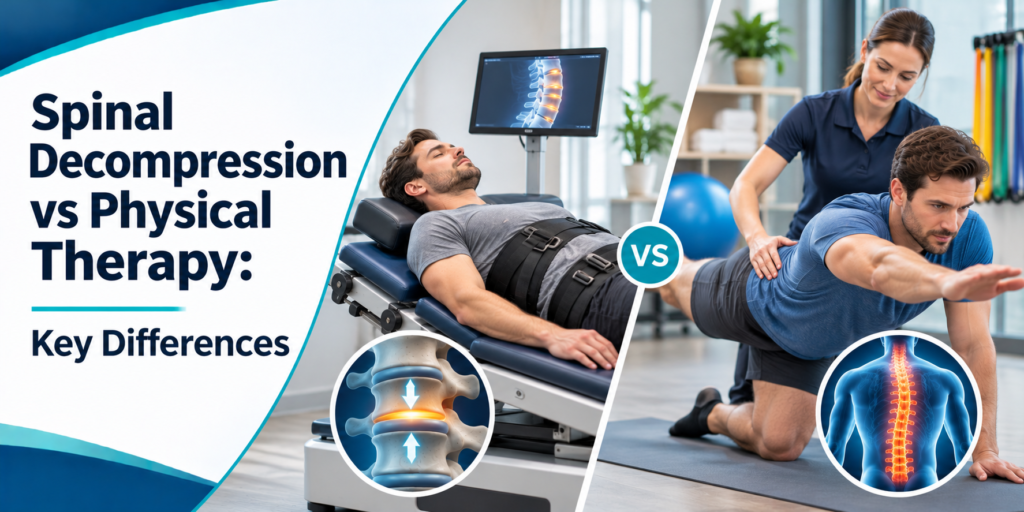
With physical therapy, you’re involved in your own recovery rather than simply receiving treatment. A therapist assesses your movement, identifies muscles that may be weak or tight, and puts together a plan that may include strengthening, stretching, and hands-on techniques. Depending on your needs, sessions may also involve heat or electrical stimulation. This makes physical therapy a well-supported option for back pain rehabilitation. The American College of Physicians recommends nondrug treatments as an initial approach, including exercise and multidisciplinary rehabilitation for people with chronic low back pain. Results rarely happen overnight. Practicing the exercises at home is a key part of making progress.
What Spinal Decompression Does
Spinal decompression is passive. You lie on a table with a harness around your hips while a computer controlled system gently stretches the spine in cycles. The goal is to lower pressure inside the discs and give irritated nerves some room. It’s a modern form of spinal traction therapy, with more precise control than older weight based setups. Insurance documents often call it vertebral axial decompression. Expect a firm stretch, not pain.
Fit matters. Spinal decompression therapy is mainly used for disc related problems like bulging discs, herniated discs, and sciatica. It isn’t for everyone. Pregnancy, spinal fractures, tumors, infection, and some prior spine surgeries are common reasons to skip it, so an exam comes first. Someone whose back is stiff from months of sitting may do better with exercise alone.
Key Differences at a Glance
Think of it like this. One builds the muscles that protect your spine. The other changes pressure on a specific irritated spot. That’s why many clinics treat them as partners inside one conservative spine treatment plan instead of rivals.
- Style: Physical therapy is hands on and movement based. Decompression is mostly lying still.
- Target: Physical therapy trains how your whole body moves. Decompression focuses on discs and nerve roots.
- Homework: Physical therapy assigns daily exercises. Decompression happens in the office.
- Best for: Physical therapy suits strength, mobility, and posture problems. Decompression suits disc related back or leg pain.
What the Research Says
Here’s where things stand with the research: the evidence remains mixed. A 2024 Cureus study looked back at patient records involving chronic low back pain associated with disc problems. Researchers compared standard physiotherapy with motorized traction and spinal decompression. Both traction groups showed greater improvement than the group receiving physiotherapy alone, while the two traction approaches produced similar results. This is why nonsurgical decompression is worth considering carefully rather than accepting every claim at face value. The study was retrospective, though, so it doesn’t provide the same level of evidence as a well-designed clinical trial. Some insurers still consider motorized traction unproven because the available studies are small and have limitations in quality. Ask your provider what research supports their recommendation.
Your work habits may also affect your back. Heavy lifting, lengthy drives, and sitting for most of the workday can all place ongoing stress on the spinal discs. The same Cureus study identifies physically demanding jobs as one risk factor for chronic low back pain. When stretching and rest aren’t doing enough, spinal decompression for work-related back pain may come up as a treatment to consider. The important thing is to look at your symptoms rather than assume the job itself explains everything. Pain that shoots down the leg or worsens when you sit or bend may be linked to a disc problem. More general muscle tightness often feels better when you move around.
How to Choose
A few basic questions can help guide the next steps. Where does your back pain spread? How long has it been going on? What have you already done to relieve it? When pain begins after lifting, it often settles with time, heat, and gentle movement. In the majority cases of acute low back pain improve even when different treatment approaches are used. But if the pain continues beyond 12 weeks or causes tingling that travels down your leg, it’s time to look more closely at the cause. A combination of back pain rehabilitation and targeted care for a disc problem may be worth discussing. Your history can help determine which approach makes sense first.
Some warning signs require immediate medical attention. New bladder or bowel control problems, numbness around the groin, sudden weakness in a leg, or back pain accompanied by fever or following a major fall require immediate medical evaluation. In these situations, neither physical therapy nor nonsurgical decompression should be the first step. Go to the emergency room immediately.
You also have local care options. If you live near Norristown, Plymouth Meeting, or Conshohocken, chiropractic care in Norristown PA may involve an examination, a review of any existing imaging, and a treatment plan that includes traction, adjustments, or soft tissue techniques. Ask how the provider will track your progress and when they would recommend seeing another specialist. A good provider should explain the plan clearly.
Conclusion
Physical therapy builds the strength and movement that keep pain from coming back. Spinal decompression targets pressure on irritated discs and nerves. The better choice depends on your symptoms, your exam, and how long the pain has lasted. Whichever of the disc pain treatment options you lean toward, many people end up using both. Get a proper evaluation before you commit to either.
Ready to Find the Right Fit for Your Back?
Still not sure which path makes sense? Contact Lifeline Chiropractic to schedule an evaluation with Dr. James Stein in Norristown, PA. We’ll help you understand your options.
FAQs
Is spinal decompression better than physical therapy?
Neither wins for everyone. Decompression targets disc and nerve pressure, while physical therapy builds strength and movement. Your symptoms decide which fits better.
Does spinal decompression hurt?
It shouldn’t. Most people feel a gentle pull or stretch. If something feels sharp, tell your provider right away.
How many sessions will I need?
It varies. The Cureus study used three sessions a week, and plans often run several weeks. Your provider should recheck your progress along the way.
Can I do both at the same time?
Often, yes. That same study added decompression on top of conventional physiotherapy. Ask your providers to coordinate.
Will insurance cover it?
Coverage varies, and some insurers call motorized traction unproven. Call your plan before booking and ask about the specific billing code.